 LNEYA Thermo Refrigeration Co.,Ltd


The Effect of Battery Test Temperature Simulation System on Testing Electric/Hybrid Vehicle Cooling
In the electric vehicle industry, batteries are an important part of automobiles, and their performance directly affects the performance of hybrid/electric vehicles. For this reason, relevant manufacturers in the market have launched a battery cooling system test temperature simulation system to efficiently perform battery module charge and discharge tests.
Due to the limited space of the vehicle, the accumulation of heat generated during the operation of the battery will cause uneven temperature everywhere and affect the consistency of the battery cells. Thereby reducing the battery charge and discharge cycle efficiency, affecting the power and energy of the battery, in severe cases, it will also lead to thermal runaway, affecting system safety and reliability. In order to make the battery pack play better performance and life, the battery needs to be thermally managed to control the temperature of the battery pack within a reasonable range.
The battery thermal management system is one of the key technologies to deal with the battery’s thermal related problems and ensure the performance, safety and life of the power battery. The main functions of the thermal management system include: effective heat dissipation when the battery temperature is high to prevent thermal runaway accidents; preheating when the battery temperature is low, raising the battery temperature, ensuring charging and discharging performance and safety at low temperatures; Reduce the temperature difference within the battery pack, suppress the formation of local hot spots, prevent the battery from decaying too fast at high temperature locations, and reduce the overall life of the battery pack.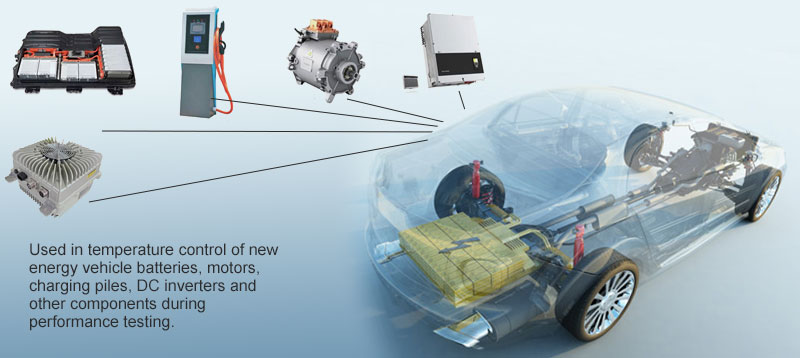
The temperature environment in the battery pack (PACK) has a great influence on the reliability, life and performance of the battery cell. Therefore, it is particularly important to maintain the temperature within the PACK within a certain temperature range. Air cooling is a kind of heat dissipation method that uses low temperature air as a medium and uses heat convection to reduce the temperature of the battery. It is divided into natural cooling and forced cooling (using a fan, etc.). Liquid cooling technology uses liquid convection heat exchange to remove the heat generated by the battery and reduce the battery temperature. The liquid medium has a high heat transfer coefficient, a large heat capacity, and a fast cooling rate. It has a significant effect on reducing higher temperatures and improving the consistency of the temperature field of the battery pack. At the same time, the volume of the thermal management system is relatively small. Direct cooling (refrigerant direct cooling) uses the principle of refrigerant (R134a, etc.) to evaporate latent heat, establish an air-conditioning system in the vehicle or battery system, install the evaporator of the air-conditioning system in the battery system, and the refrigerant evaporates in the evaporator And quickly and efficiently remove the heat from the battery system to complete the cooling of the battery system.
The heat-related problems of the battery are the key factors that determine its performance, safety, life and cost. The test cooling cycle system is an essential test equipment for new energy vehicles, battery modules, and battery PACK liquid cooling tests. Testing of motor and its controller. LNEYA battery cooling system test temperature simulation system effectively promotes the development of power battery performance, safety and life.
Related recommendations
-
How to clean air control system?
2383In order to respond to the requirements of the two types of society in the country, environmental protection and conservation have become increasingly important. Therefore, in order to extend the life of the product, it is still necessary to have ...
View details -
Semiconductor refrigeration temperature control system accessories
2164In the evaporator, since the liquid evaporates in the evaporator of the semiconductor refrigeration temperature control system, the process from liquid to gas, due to the change of the load, some of the refrigerant may not be completely evaporated...
View details -
Application of Chiller
2147With the rapid development of modern industrial technology, in order to improve production efficiency, improve product quality and reduce production costs, the requirement of temperature control in production process is becoming higher and higher....
View details -
High and low temperature humidity test chamber performance
23821. It has wide temperature control range, which can meet the needs of users.2. With a unique balanced temperature control method, with stable and balanced heating capacity, high precision and high stable temperature control can be carried out;The ...
View details


