 LNEYA Thermo Refrigeration Co.,Ltd


What are the maintenance of glycol chillers in daily operation?
In the daily operation of the glycol chiller, if the maintenance is not in place, the cooling effect will be reduced. Therefore, in order to improve the operating efficiency, we recommend that you carry out the necessary daily maintenance.
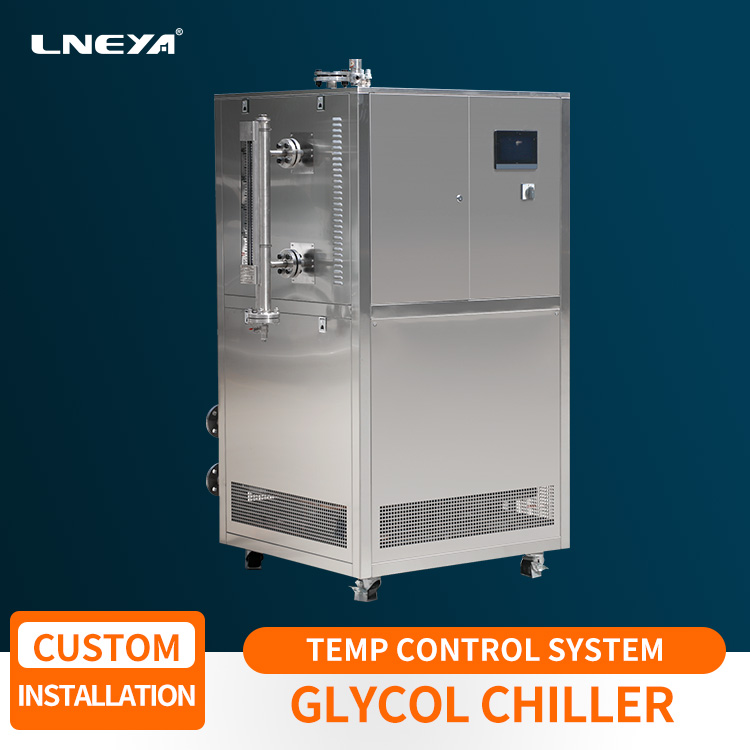
Refrigeration system inspection: Generally, after long-term use of ethylene glycol chillers, various problems will inevitably occur. In the event of a failure, the use of each part of the machine should be carefully checked, focusing on the refrigeration system, electrical system, air system and water system to determine whether their functions are normal. We usually examine them by sound and appearance. If there is a problem, it is recommended to replace it in time.
Refrigerant inspection: Regularly check whether the refrigerant of the glycol chiller leaks: It can be determined by referring to the parameters displayed by the high and low pressure meter on the front panel of the main unit. According to the temperature change of the air temperature (winter and summer), the pressure display of the glycol chiller is also different. When the low temperature chiller is working normally, the high pressure shows 11-17kg, and the low pressure shows 3-5kg.
Cooling water system inspection: It is normal to check whether the cooling water system of the ethylene glycol chiller is normal, whether the cooling water tower fan and water spray shaft are in good operation, and whether the water supply in the built-in water tank of the chiller is normal.
System cleaning: Glycol chillers should be cleaned annually after six months of use. The main cleaning parts include cooling water tower, cooling water pipe and condenser to ensure good cooling effect.
Voltage and current inspection: Regularly check whether the voltage and current of the glycol chiller are stable and whether the compressor is running normally. When the glycol chiller works normally, the voltage is 380V and the current is in the range of 11a-15a.
The above aspects are some of the areas that require routine maintenance. Of course, there are many other details that need your attention.
Related recommendations
-
Analysis of the characteristics of LNEYA precision chillers
2089Now, in many industrial productions, industrial chillers are needed to achieve the purpose of refrigeration in production operations. This shows that chillers play a very important role in various industrial production. The precision chiller uses ...
View details -
How to replace the four-way valve of industrial refrigeration equipment?
1725The four-way valve of industrial refrigeration equipment needs to be replaced in time after a long period of use, so how to replace it? When replacing industrial refrigeration equipment, you need to first remove the connecting pipe connecting the ...
View details -
What Are the Commonly Used Refrigerants For Brand Selection of Refrigerating Chillers?
2358When the enterprise chooses the refrigerant in the cryo chillers unit brand, what should it need to pay attention to the present market commonly used refrigerant? What is the difference between specific refrigerant properties? Take a look at the b...
View details -
Parts Analysis of Low Temperature Chiller
2521The low temperature chiller is a cooling water equipment which is widely used. So, when using it, you should first understand the principle of the cryogenic water chiller and its accessories, so as to run the cryogenic water chiller more efficient...
View details


