 LNEYA Thermo Refrigeration Co.,Ltd


What should I pay attention to when adding refrigerant to a water-cooled chiller
In our life, we believe that everyone is
very familiar with refrigeration. In the central air conditioning and
industrial production process cooling industry, small water-cooled chillers is
more common. This unit is composed of a compressor in the fuselage, a
horizontal shell and tube condenser, an evaporator, a thermal expansion valve,
and some related parts. Under the cooperation of these auxiliary parts, the
overall small water cooled chiller is compact in structure, convenient in
operation and control, and is popular among the public in the market.
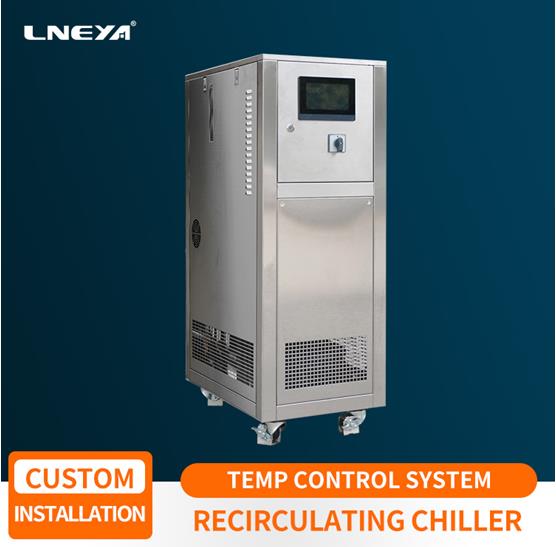
For refrigeration systems that do not have
a high pressure reservoir and a low pressure vapor-liquid separator, the
control of refrigerant charge is particularly important. Because the
refrigeration system is a condenser and also acts as a high-pressure reservoir,
the refrigerant is stored in the condenser, and the condenser is cooled. The
heat dissipation area is reduced and the condensing pressure is increased,
resulting in a decrease in cooling capacity.
For the control of the refrigerant charge
of such small water-cooled chillers, the following methods are followed during
the filling process:
First, touch the temperature of the
condenser casing.
The upper outlet of the condenser outlet is
heated above the outlet, and the outlet below the outlet is cool. (There is a
description of the high temperature exhaust of the compressor in the inside.
The cooling indicates that the small water-cooled chillers is a liquid space.)
Second, look at the inspiratory pressure.
Corresponding to the temperature of the
refrigerant water in the evaporator. (That is, corresponding to the evaporation
temperature.)
Third, look at the compressor return pipe
temperature.
The high-temperature unit return pipe
should be cooled and dew, but it can be dew condensation to the compressor
return valve; the low-temperature unit return pipe should be frosted, but the
frost can be connected to the compressor return valve. If condensation or frost
builds up on the compressor casing, liquid refrigerant will enter the
crankcase, causing the compressor to run back and cause liquid
problem.
The above is a partial analysis of our
LNEYA technicians for water-cooled chillers. Regarding the specific use of our
water-cooled chillers, you can contact us sales@lneya.com for more detailed
instructions.
Related recommendations
-
What should we pay attention to when purchasing cooling equipment for industrial chiller units?
1747When many customers buy refrigeration equipment for industrial chiller units, they don't know what the key points are. Next, let me talk to you. 1. It should be determined according to the use, refrigerating capacity, local power supply, water sou...
View details -
Won the “2021 High Quality Development Award”
3001On the afternoon of May 8, 2022, the 2020 Annual Summary and Commendation Conference was held in Hongshan Street, Wuxi City. Wuxi Guanya Constant Temperature Refrigeration Technology Co., Ltd. (LNEYA) won the "2020 Outstanding Contribution Award"...
View details -
Semiconductor temperature test system application range description
2981The semiconductor temperature test system is LNEYA's new device for semiconductor chip testing. So what range does the semiconductor temperature test system apply? Users need to understand the specific application range to select the appropriate s...
View details -
What are the conditions for the decarboxylation reaction? How to control the temperature of heating?
2516The decarboxylation of aromatic acids is easier than that of fatty acids. For example, benzoic acid can be decarboxylated by adding a little copper powder as a catalyst in quinoline solution and heating. When a strong electron-withdrawing group i...
View details


