LNEYA Thermo Refrigeration Co.,Ltd


How to control the emulsification temperature of the emulsifier?
A good cream product is not only reflected in the quality of raw materials, but also has a great influence on the emulsification process during production, such as the texture and stability of the product, and the temperature control during production will affect the cream product.
Generally speaking, the emulsification temperature is determined by factors such as the melting point of the high melting point substance contained in the two phases, the type of emulsifier, the solubility of the oil phase and the water phase, etc. In addition, the temperature of the two phases needs to be kept at nearly the same state, especially for waxy and fatty oil phase components with a higher melting point, that is, the temperature is above 70. They cannot add a low-temperature water phase during emulsification to prevent emulsification before emulsification. Crystallization of wax and fat results in blocky or rough and uneven emulsion. The emulsification temperature sometimes also affects the size of the emulsion particles. For example, when the fatty acid soap anionic emulsifier is generally used for emulsification by the nascent soap method, the emulsion particle size is about 1.8-2.0 microns when the emulsification temperature is controlled at 80 degrees. When emulsifying, the particle size is about 6 microns. However, when non-ionic emulsifiers are used for emulsification, the effect of emulsification temperature on particle size will be relatively weak.

When emulsifying, the temperature of the oil and water phases can be controlled at 75 to 85 degrees. If the oil phase has components such as wax with a high melting point, the emulsification temperature should be higher at this time. In addition, if the viscosity increases during the emulsification process, it will also affect the stirring, so it is necessary to increase the emulsification temperature appropriately.
Tank bottom emulsifier, pipeline emulsifier, vacuum emulsifier, dispersion emulsifier, etc. are used in daily chemical, fine chemical, biopharmaceutical and cosmetic production. In the mixing and stirring process, a large part of material processing requires heating function to achieve the effect of high-quality finished products.
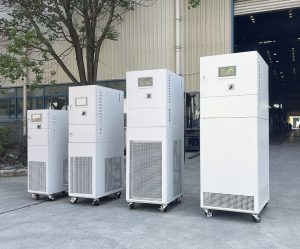
Heating methods include electric heating and dynamic heating. Electric heating requires a built-in functional module of the emulsifier, which can adjust the temperature easily and portablely, but the temperature uniformity is poor and cannot be cooled. Dynamic heating is our dynamic temperature control system SUNDI series. Heat transfer oil with different temperature points is used as the medium, which can not only heat but also cool. The emulsifier itself and the temperature of the material can be set to control the temperature. range, SUNDI-135 is used by customers for cooling and heating of emulsifiers. The temperature of the material in the reactor can be controlled and the temperature rise and fall curves can be displayed on the control panel, the temperature difference can be set independently, and the temperature control accuracy can also be adjusted.
Related recommendations
-

Ethylene glycol refrigeration unit made a strong attack and created LNEYA brand in 12 years
2619Performance enhanced positioning When performing the cooling and heating reaction, in many cases, the refrigerant cannot cool the object to be cooled by itself. Therefore, we need a coolant (or refrigerant) to cool the refrigeration system in a re...
View details -
Overhaul Method for Reducing the Efficiency of Industrial Chiller
2061Friends who come into contact with industrial chillers during their work may encounter problems in the title: inefficiency of industrial water chillers - what to do? In fact, when the efficiency of industrial chillers has troubles, overhaul is the...
View details -

Where do you need explosion-proof water chillers?
1822Explosion-proof refrigeration unit water chillers (explosion-proof chillers) are mainly used in environments with explosion risks to ensure the safety and reliability of the cooling process. This type of equipment is specially designed to operate ...
View details -
How to Solve the Problem of Compressor Noise in Industrial Low Temperature Chiller?
2522In industrial low temperature chiller, compressor operation will produce noise, but only the difference of sound size. Generally speaking, there will be some problems if the noise is too large. So, how to solve the problem of compressor noise? Gen...
View details