LNEYA Thermo Refrigeration Co.,Ltd


The Refrigeration Principle of Heating Cooling Circulator
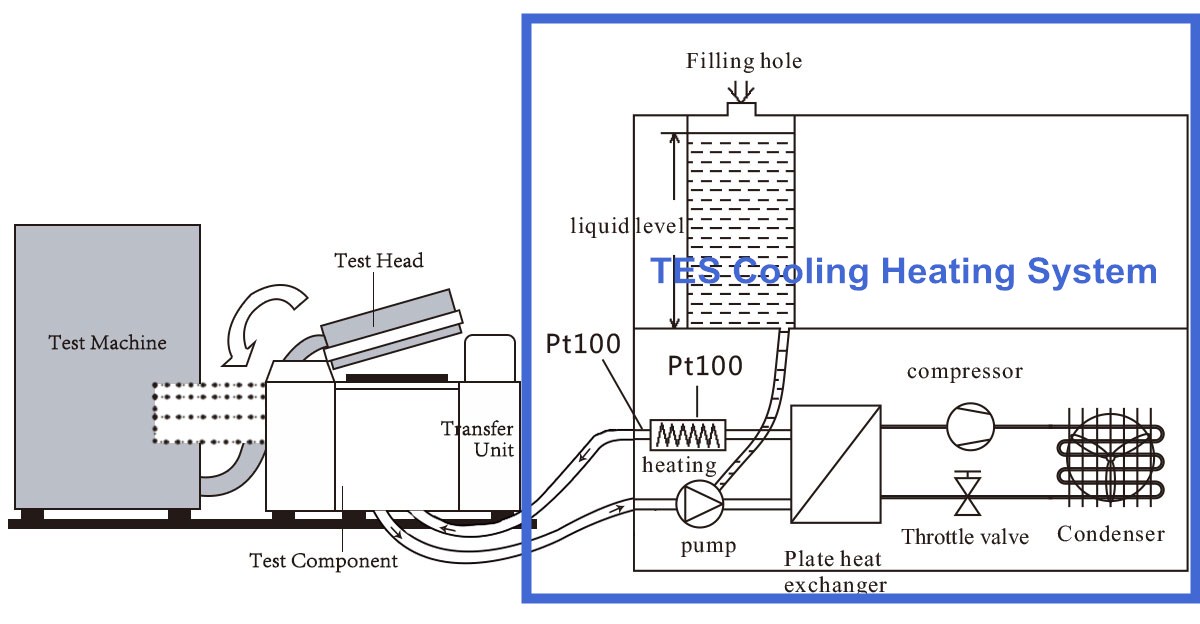
Heating cooling circulator is the use of limited refrigerant in the closed refrigeration system, repeatedly refrigerant compression, condensation, expansion, evaporation, constantly in the evaporator heat absorption vaporization, cooling.
The heating cooling circulator is the circulation process that moves the heat from the low temperature object (such as the cold storage) to the high temperature object through the refrigerant, so as to cool the object below the ambient temperature and maintain the low temperature. This process is realized by the refrigeration device
The important parameter of the heating and cooling circulator is the coefficient of refrigeration, also known as the performance coefficient of the refrigeration unit, represented by the symbol COP. At a given ambient temperature, the lower the temperature of the cold storage, the smaller the coefficient of refrigeration.
The whole liquid cycle is closed, with the expansion vessel, the expansion vessel and the liquid cycle are insulated, do not participate in the liquid cycle, just mechanically connected, temperature the medium in the expansion vessel is less than 60 degrees no matter the liquid cycle temperature is high or low.
The whole liquid circulation is a closed system. At low temperature, there is no water vapor absorption, and at high temperature, there is no oil mist generation. Thermal oil has a wide range of operating temperature. No mechanical or electronic valves are used throughout the system.
Analysis of refrigeration principle
01.Compressed air refrigeration cycle
Due to the air constant temperature heating and constant temperature exhaust heat is not easy to achieve, so it can not run by the reverse cycle. In the compressed air refrigeration cycle, two constant pressure processes are used to replace the two constant temperature processes of the reverse cycle, so it can be regarded as the reverse cycle. In engineering applications, the compressor may be either piston or impeller type.
02.Compressed vapor refrigeration cycle
The reverse refrigeration cycle of compressed steam can be achieved in theory, but it will appear that the dry state is too low, which is not a positive factor for two-phase material compression. In order to avoid adverse factors, increase the refrigeration efficiency and simplify the equipment, in practical applications often use throttle valve (or expansion valve) to replace the expander.
Related recommendations
-

What are the advantages and disadvantages of thermal oil heating circulators?
2308The heat conduction oil heating circulator adopts a fully closed loop structure to directly act on the heat energy to the heated medium. Its advantages are: (1) Due to the continuous renewal of the heat transfer surface, the heat loss is small; (...
View details -
Troubleshoot fan failures in the cooling system of the engine powertrain
2185The fan is generally installed at the upper end of the cooling system of the engine powertrain, and some customers choose to install it on the side according to regulations. For screw chillers that use fans to dissipate heat, they are called air-c...
View details -

The significance of temperature in IC testing
3220Every integrated circuit (IC) goes through two type of tests before it can be sold and used to build a product: the first is called a wafer test; the second is called final test. With the improvement of integrated circuit electrical test technolog...
View details -
Analysis of Advantages and Disadvantages of Screw Water Chiller
2591Compared with other types of chillers, the overall energy consumption of high-quality screw water chiller is relatively small. Because the production technology of screw water chiller is more advanced and less energy is used, the equipment can qui...
View details