 LNEYA Thermo Refrigeration Co.,Ltd


How Cooling Towers and Chillers Work Together
Plants and labs rarely say cooling is optional. When a process runs hot, product quality or uptime pays the price. A water cooled chiller plus a cooling tower form the basic heat rejection system in many facilities. The pairing looks simple but it has many moving parts. Knowing what each piece does and how they hand off heat lets you spot trouble fast.
What is an Industrial Chiller
A chiller removes heat from a process fluid and delivers chilled water to the load. It uses a refrigeration cycle with an evaporator, compressor, condenser, and expansion device.
In water cooled designs the condenser dumps heat into a condenser water loop. Pumps move that warm condenser water to the cooling tower. Chillers control chilled water setpoint, monitor pressures, and protect the compressor.

What is a Cooling Tower
A cooling tower rejects heat to the atmosphere by evaporating a small portion of the water. Warm condenser water from the chiller arrives at the top of the tower. The water spreads over fill media while air flows through the fill. A small fraction of the water evaporates.
That evaporation removes heat from the remaining water which then drops into the tower basin. Pumps return the cooled water to the chiller condenser and the cycle repeats.
Key components of a tower include the fill media, nozzles, drift eliminators, fan and motor, distribution basin, and the cold water basin. Fill media provides surface area for heat transfer. Nozzles make the water spray so air can contact it.
Drift eliminators stop small droplets from escaping the tower and reduce water loss. The fan moves air and sets the airflow rate that the tower needs to achieve the target outlet temperature.
Cooling towers come in a few common styles. Induced draft towers have fans that pull air up through the fill. Forced draft towers push air into the tower with fans at the inlet. Crossflow towers let water fall vertically across the fill while air crosses horizontally. Counterflow towers have air rising opposite to falling water which gives tighter approach temperatures.

How Cooling Towers and Chillers Work Together
1 Warm process heat moves into the chiller evaporator
Process fluid flows into the evaporator. The refrigerant boils and absorbs heat. Chilled water leaves the evaporator at the setpoint and goes back to the process. Meanwhile the refrigerant vapor goes to the compressor. This is the point where process heat first enters the refrigeration loop.
2 Compressor raises refrigerant pressure and temperature
The compressor pumps the vapor to a higher pressure and raises its temperature. This step concentrates the heat so it can be rejected.
3 Heat moves to the condenser water loop
The hot refrigerant flows into the condenser. It transfers heat into the condenser water. This water leaves the chiller warmer and travels via pump to the cooling tower.
4 Cooling tower strips heat from the condenser water
The warm condenser water reaches the tower distribution nozzles. Water spreads across the fill. Air flows through the fill and a portion of the water evaporates. Evaporation cools the remaining water. The cooled water collects in the basin.
5 Cooled condenser water returns to the chiller
Pumps send the colder water back to the chiller condenser. The lower the condenser water temperature, the lower the chiller head pressure and the less energy the compressor uses.
6 Control loops and sequencing keep the balance
Chiller controls modulate compressor capacity to match load. Tower fans and water pumps have their own controls. In many plants operators set tower fan speed based on condenser approach or head pressure. When both control systems are tuned the chiller and tower meet load efficiently. If controls are misaligned the system hunts and wastes energy.
7 Seasonal and transient adjustments
In winter or cool nights operators slow fan speed or cycle the tower to prevent overcooling. During peak heat daytime the tower must handle higher heat rejection. Side stream filtration and chemical dosing help the tower stay clean under variable conditions.
Conclusion
A water-cooled chiller and cooling tower form a single heat rejection system where each part affects the other. The chiller moves heat from the process into the condenser water loop. The tower then rejects that heat to the air.
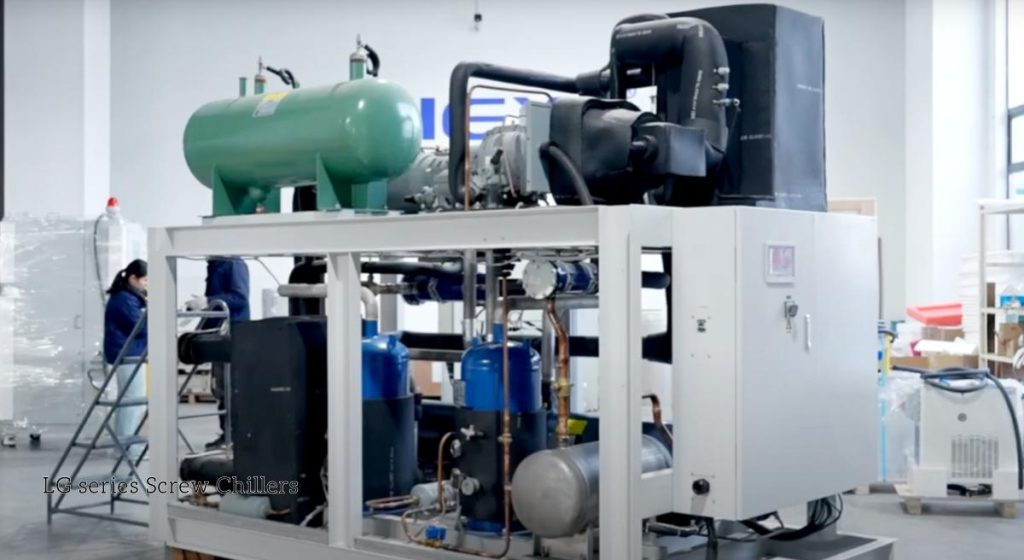
If you need a water-cooled chiller system to complement your cooling tower, we can offer a range of screw and scroll chillers to suit your specific requirements. We can also customize the system based on your operational needs.

Recent Blogs
- LNEYA, 칭화대학교와 고출력 칩 열관리 핵심기술 공동연구 협력 체결
- LNEYA at ASPS 2026 | Advanced Semiconductor Packaging & Chiplet Show Korea
- What Does a 200 Ton Chiller Cost
- Temperature Control in Photolithography
- Is a Used Chiller a Good Idea
- Chiller Components and Refrigeration Fundamentals Guides
- Chiller Types and Selection Guides
- How Does a Peltier Cooler Work
Catalog
- 2026년 9월
- 2026년 6월
- 2025년 12월
- 2025년 11월
- 2025년 10월
- 2025년 9월
- 2025년 8월
- 2025년 7월
- 2025년 6월
- 2025년 5월
- 2025년 3월
- 2025년 2월
- 2025년 1월
- 2024년 12월
- 2024년 11월
- 2024년 10월
- 2024년 9월
- 2024년 8월
- 2024년 7월
- 2024년 6월
- 2024년 5월
- 2024년 4월
- 2024년 3월
- 2024년 2월
- 2023년 9월
- 2023년 7월
- 2023년 6월
- 2023년 5월
- 2023년 1월
Tag
air cooled chiller chiller Chiller Installation Chiller Maintenance chiller refrigerant chillers Cold Assembly Freezer cooling chiller cooling heating system cooling system dynamic temperature control system energy efficient chiller explosion-proof chiller freezer heating circulator industrial chiller industrial chillers industrial cooling industrial freezer industrial refrigerator jacket reactor laboratory chiller low temperature chiller news oil chiller process chiller process cooling reactor chiller reactor cooling reactor cooling heating reactor heating cooling refrigerated circulator screw chiller semiconductor chiller semiconductor test chiller sundi tcu temperature control test chamber thermostat ultra low temperature chiller vehicle test chiller water chiller water cooled chiller
Contact Us
Related Chillers



CONTACT US
TEL:
EMAIL:
WeChat & WhatsApp:

Wechat QR

Have a question or need a quote? Fill out the form below, and our team will get back to you within 24 hours.


